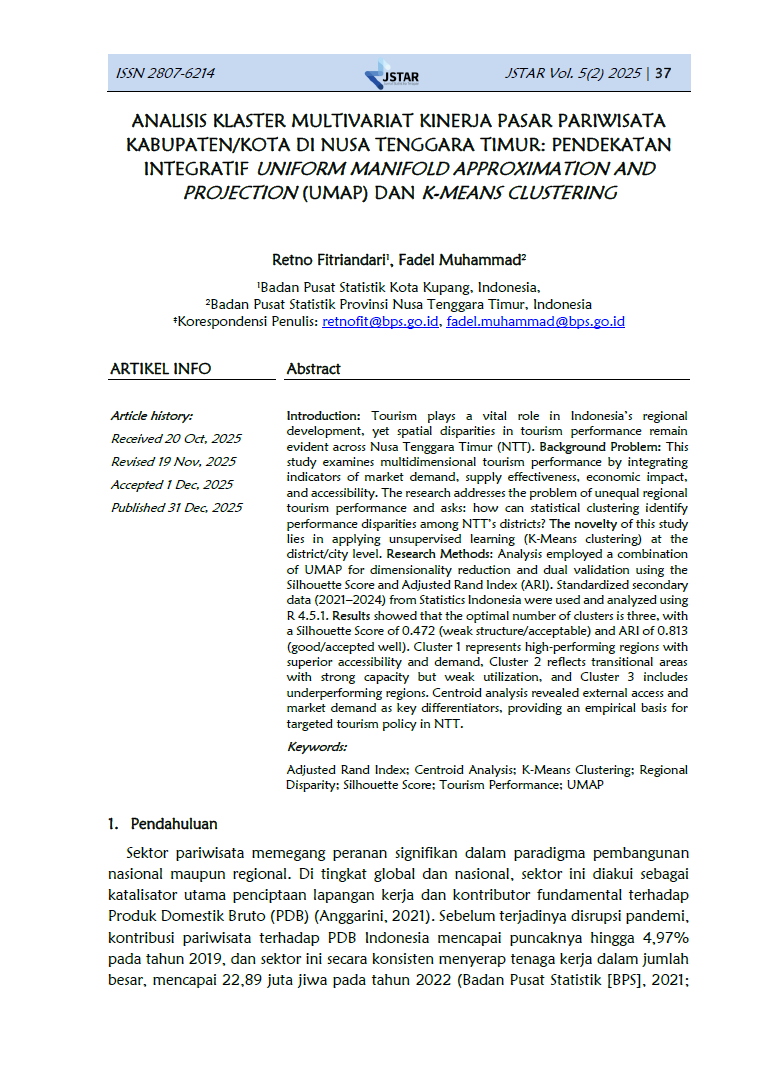
ANALISIS KLASTER MULTIVARIAT KINERJA PASAR PARIWISATA KABUPATEN/KOTA DI NUSA TENGGARA TIMUR: PENDEKATAN INTEGRATIF UNIFORM MANIFOLD APPROXIMATION AND PROJECTION (UMAP) DAN K-MEANS CLUSTERING
DOI:
https://doi.org/10.64930/jstar.v5i2.128Kata Kunci:
Adjusted Rand Index; Centroid Analysis; K-Means Clustering; Regional Disparity; Silhouette Score; Tourism Performance; UMAPAbstrak
Tourism plays a vital role in Indonesia’s regional development, yet spatial disparities in tourism performance remain evident across East Nusa Tenggara (NTT). This study examines multidimensional tourism performance by integrating indicators of market demand, supply effectiveness, economic impact, and accessibility. The research addresses the problem of unequal regional tourism performance and asks: How can statistical clustering identify performance disparities among NTT’s districts? The novelty of this study lies in applying unsupervised learning (K-Means clustering) at the district/city level, combining UMAP for dimensionality reduction and dual validation using the Silhouette Score and Adjusted Rand Index (ARI). The study employs standardized secondary data (2021–2024) from Statistics Indonesia, analyzed using R 4.5.1. Results show that the optimal number of clusters is three, with a Silhouette Score of 0.472 (moderate structure) and ARI of 0.813 (excellent recovery). Cluster 1 represents high-performing regions with superior accessibility and demand, Cluster 2 reflects transitional areas with strong capacity but weak utilization, and Cluster 3 includes underperforming regions. Centroid analysis reveals external access and market demand as key differentiators, providing an empirical basis for targeted tourism policy in NTT.
Unduhan
Referensi
Ahmed, M. (2020). The k-means Algorithm: A Comprehensive Survey and Performance Evaluation. Electronics, 9(8), 1295. https://doi.org/10.3390/electronics9081295
Amanda, L. F. P., & Setiawan, A. B. (2022). Grouping the Number of Foreign Tourist Visits and Analysis of Tourism Competitiveness in East Java. Efficient: Indonesian Journal of Development Economics, 5(3), 103–114.
Anggarini, F. (2021). Peran sektor pariwisata terhadap pertumbuhan ekonomi di ASEAN 4 (Thailand, Singapore, Malaysia, dan Indonesia). Jurnal Industri Pariwisata, 6(2), 1-13. https://doi.org/10.36441/pariwisata.v7i1.2059
Badan Pusat Statistik. (2021). Indonesia Tourism Satellite Accounts (TSA) 2016-2019. Jakarta: Badan Pusat Statistik.
Costa, A. C. da R. (2013). Toward a Formal Reconstruction of Kelsen’s Theory of Legal Systems. 2013 2nd Workshop-School on Theoretical Computer Science, 165–171. https://doi.org/10.1109/WEIT.2013.23
Hariyani, H. F. (2022). Tourism Sector Performance on Indonesia’s Economic Growth. Jurnal Ekonomi Pembangunan, 20(2), 145–158. https://doi.org/10.22219/jep.v16i1.8184
Jain, A. K. (2010). Data clustering: 50 years beyond K-Means. Pattern Recognition Letters, 31(8), 651–666.
https://doi.org/10.1016/j.patrec.2009.09.011
Kaufman, L., & Rousseeuw, P. J. (2005). Finding Groups in Data: An Introduction to Cluster Analysis. Wiley. https://doi.org/10.1016/0377-0427(87)90125-7
Kementerian Koordinator Bidang Perekonomian Republik Indonesia. (2025, Maret 13). Mendongkrak kinerja sektor pariwisata, pemerintah siapkan berbagai program lintas sektor. Kementerian Koordinator Bidang Perekonomian Republik Indonesia. https://www.ekon.go.id/publikasi/detail/6253/mendongkrak-kinerja-sektor-pariwisata-pemerintah-siapkan-berbagai-program-lintas-sektor
Kementerian Pariwisata dan Ekonomi Kreatif (Kemenparekraf). (2023). Outlook Pariwisata dan Ekonomi Kreatif Indonesia 2023/2024. Jakarta: Kemenparekraf.
Maori, N. A. & Evanita, E. (2023). Metode Elbow dalam Optimasi Jumlah Cluster pada K-Means Clustering. Simetris: Jurnal Teknik Mesin, Elektro dan Ilmu Komputer, 14(2), 277-288. https://doi.org/10.24176/simet.v14i2.9630
Masteriarsa, M. F., & Riyanto, R. (2023). Tourism destination mapping based on tourism characteristics and carrying capacity of province in Indonesia. Jurnal Perencanaan Pembangunan: The Indonesian Journal of Development Planning, 7(3), 344-361. https://doi.org/10.36574/jpp.v7i3.460
McInnes, L., Healy, J., & Melville, J. (2018). UMAP: Uniform manifold approximation and projection for dimension reduction. arXiv preprint arXiv:1802.03426. https://arxiv.org/abs/1802.03426
Mertayasa, I. K. T., & Atmaja, I. D. M. B. (2022). Pemodelan topik pada ulasan hotel menggunakan metode BERTopic dengan prosedur c-TF-IDF. Jurnal Nasional Teknologi Informasi dan Aplikasinya (JNATIA), 1(1), 307–316. https://doi.org/10.24843/JNATIA.2022.v01.i01.p37
Mukhtar, H., Syafriadi, S., & Rahmadani, R. (2024). Algoritma K-Means untuk pengelompokan perilaku customer. SEIS: Journal of Software Engineering and Information Systems, 4(2), 45–54. https://doi.org/10.37859/seis.v4i2.7615
Nuraeni, S., & Hendriyani, I. (2022). A Competitive Advantage Model for Indonesia’s Sustainable Tourism Destinations from Supply and Demand Side Perspectives. Sustainability, 14(24), 16398. MDPI. https://doi.org/10.3390/su142416398
Romano, S., Vinh, N. X., Bailey, J., & Verspoor, K. (2016). Adjusting for chance clustering comparison measures. Journal of Machine Learning Research, 17(1), 1-32. https://doi.org/10.5555/2946645.3007087
Rousseeuw, P. J. (1987). Silhouettes: A graphical aid to the interpretation and validation of cluster analysis. Journal of Computational and Applied Mathematics, 20, 53–65.
Saputra, D. M., Saputra, D., & Oswari, L. D. (2020). Effect of distance metrics in determining K-value in K-means clustering using elbow and silhouette method. In Proceedings of the Sriwijaya International Conference on Information Technology and Its Applications (SICONIAN 2019) (pp. 341–346). Atlantis Press. https://doi.org/10.2991/aisr.k.200424.051
Siagian, A. R., & Wulandari, D. (2025). Penerapan jarak Euclidean pada pengelompokan data menggunakan algoritma K-Means [Skripsi, Universitas Islam Negeri Sultan Syarif Kasim Riau]. UIN SUSKA Repository. https://repository.uin-suska.ac.id/85603/
Suhandi, N., Gustriansyah, R., & Destria, A. (2025). Klasifikasi penyakit TBC menggunakan metode UMAP dan K-NN. Bit-Tech (Binary Digital - Technology), 7(3). https://doi.org/10.32877/bt.v7i3.2227
Suhardiman, M. Y. (2025). Clustering Tourism Hotspots in Indonesia Using Hotel Guest Data and the K-Means Algorithm. IJRESM, 8(6), 106-111.
Tan, P.-N., Steinbach, M., & Kumar, V. (2014). Introduction to data mining. Pearson Education Limited.
Unduhan
Diterbitkan
Cara Mengutip
Terbitan
Bagian
Lisensi
Hak Cipta (c) 2025 Jurnal Statistika Terapan (ISSN 2807-6214)

Artikel ini berlisensi Creative Commons Attribution-NonCommercial 4.0 International License.