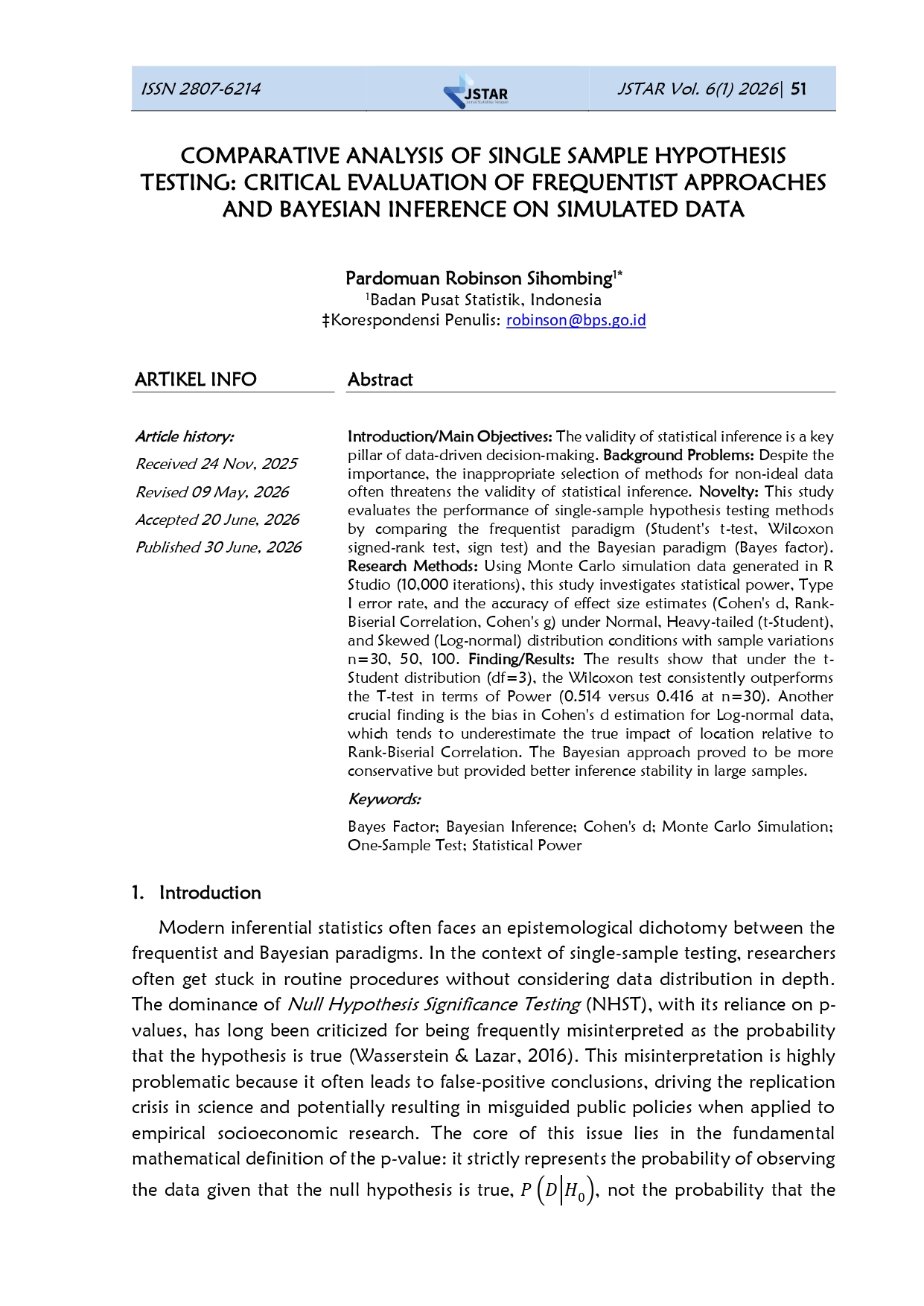
COMPARATIVE ANALYSIS OF SINGLE-SAMPLE HYPOTHESIS TESTING: CRITICAL EVALUATION OF FREQUENTIST APPROACHES AND BAYESIAN INFERENCE ON SIMULATED DATA
DOI:
https://doi.org/10.64930/jstar.v6i1.142Kata Kunci:
Bayes Factor; Cohen's d; Bayesian Inference; One-Sample TestAbstrak
The validity of statistical inference is a key pillar in data-driven decision making, but it is often threatened by the inappropriate selection of methods for non-ideal data. This study aims to evaluate the performance of single-sample hypothesis testing methods by comparing the frequentist paradigm (Student's t-test, Wilcoxon signed-rank test, sign test) and the Bayesian paradigm (Bayes factor). Through Monte Carlo simulations using R Studio with 1,000 iterations, this study investigates statistical power, Type I error rate, and the accuracy of effect size estimates (Cohen's d, Rank-Biserial Correlation, Cohen's g) under Normal, Heavy-tailed (t-Student), and Skewed (Log-normal) distribution conditions with sample variations . The results show that under the t-Student distribution ( ), the Wilcoxon test consistently outperforms the T-test in terms of power (0.514 vs. 0.416 at n ). Another crucial finding is the bias in Cohen's d estimation on Log-normal data, which tends to underestimate the actual impact of location when compared to Rank-Biserial Correlation. The Bayesian approach proved to be more conservative but provided better inference stability in large samples
Unduhan
Referensi
Blair, R. . C., & Higgins, J. J. (1980). A Comparison of the Power of Wilcoxon ’ s Rank-Sum Statistic to That of Student ’ s t Statistic under Various Nonnormal Distributions. Journal of Educational Statistics, 5(4), 309–335.
[2] Bridge, P. D., & Sawilowsky, S. S. (1999). Increasing physicians’ awareness of the impact of statistics on research outcomes: comparative power of the t-test and Wilcoxon Rank-Sum test in small samples applied research. Journal of Clinical Epidemiology, 52(3), 229–235.
[3] Cohen, J. (1988). Statistical Power Analysis for the Behavioral Sciences. In Educacao e Sociedade (2nd ed.). Lawrence Erlbaum Associates. http://www.biblioteca.pucminas.br/teses/Educacao_PereiraAS_1.pdf%0Ahttp://www.anpocs.org.br/portal/publicacoes/rbcs_00_11/rbcs11_01.htm%0Ahttp://repositorio.ipea.gov.br/bitstream/11058/7845/1/td_2306.pdf%0Ahttps://direitoufma2010.files.wordpress.com/2010/
[4] Jeffreys, H. (1961). Theory of probability. Oxford University Press.
[5] Kerby, D. S. (2014). The Simple Difference Formula: An Approach to Teaching Nonparametric Correlation. Comprehensive Psychology, 3(1), 1–9. https://doi.org/10.2466/11.it.3.1
[6] Morey, R. D., & Rouder, J. N. (2011). Bayes Factor Approaches for Testing Interval Null Hypotheses. Psychological Methods, 16(4), 406–419. https://doi.org/10.1037/a0024377
[7] Morris, T. P., White, I. R., & Crowther, M. J. (2019). Using simulation studies to evaluate statistical methods. Statistics in Medicine, 38(11), 2074–2102. https://doi.org/10.1002/sim.8086
[8] Rouder, J. N., Speckman, P. L., Sun, D., Morey, R. D., & Iverson, G. (2009). Bayesian t tests for accepting and rejecting the null hypothesis. Psychonomic Bulletin & Review, 16(2), 225–237. https://doi.org/10.3758/PBR.16.2.225
[9] Sellke, T., Bayarri, M. J., & Berger, J. O. (2001). Calibration of p values for testing precise null hypotheses. The American Statistician, 55(1), 62–71.
[10] Setiawan, E. P., & Sukoco, H. (2021). Exploring First Year University Students’ Statistical Literacy: A Case on Describing and Visualizing Data. Journal on Mathematics Education, 12(3), 427–448.
[11] Siegel, S. (1997). Statistik Nonparametrik untuk Ilmu-ilmu Sosial. PT Gramedia Pustaka.
[12] Tomczak, M., & Tomczak, E. (2014). The need to report effect size estimates revisited. An overview of some recommended measures of effect size. Trends in Sport Sciences, 1(21), 19–25.
[13] Walpole, R. E. (2012). Probability & Statistics for Engineers & Scientists. Pearson.
[14] Wasserstein, R. L., & Lazar, N. A. (2016). The ASA ’ s statement on p-values : context , process , and purpose. The American Statistician, 70(2), 70(2), 129–133. https://doi.org/10.1080/00031305.2016.1154108
Unduhan
Diterbitkan
Cara Mengutip
Terbitan
Bagian
Lisensi
Hak Cipta (c) 2026 Jurnal Statistika Terapan (JSTAR)

Artikel ini berlisensi Creative Commons Attribution-NonCommercial 4.0 International License.