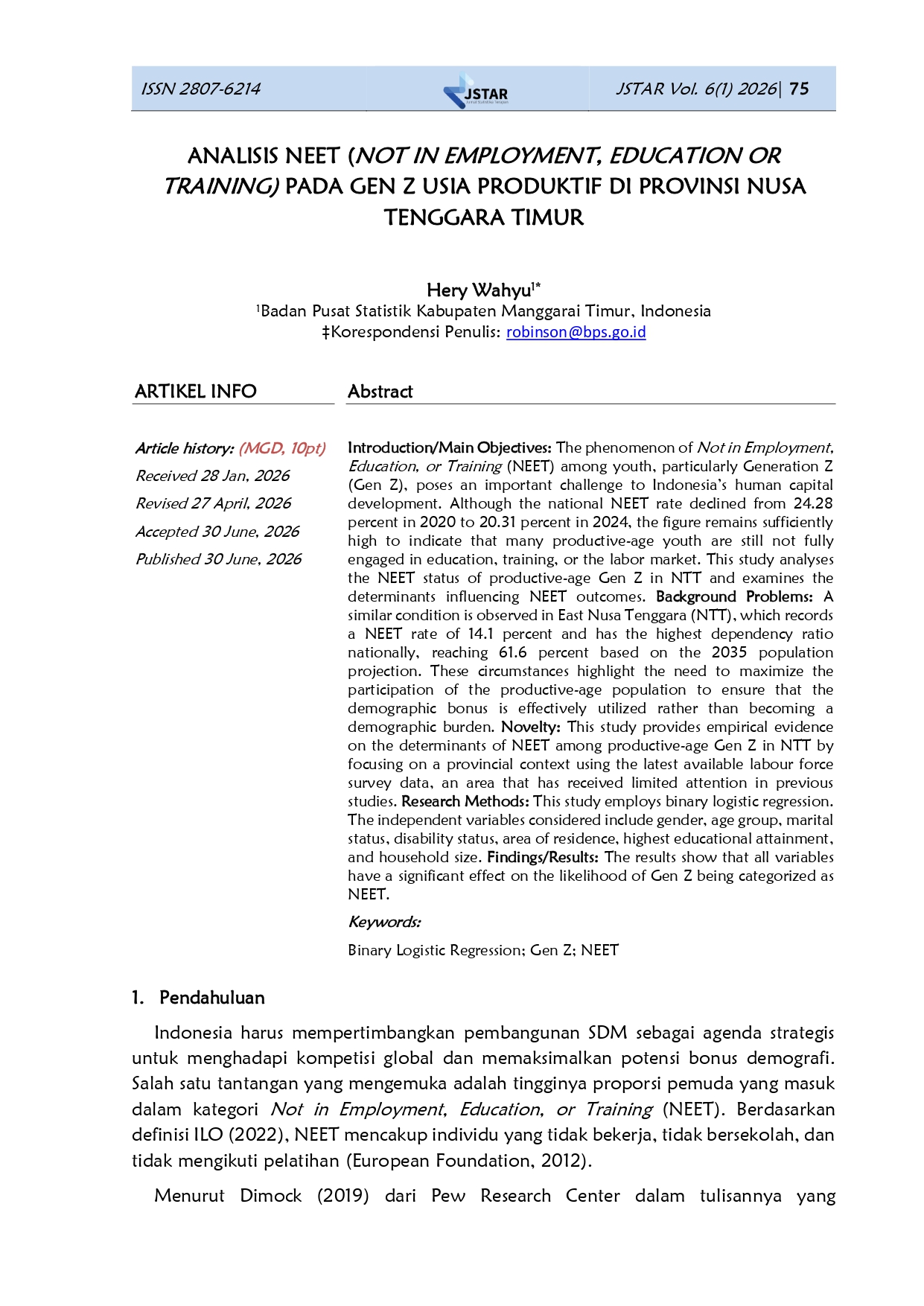
ANALISIS NEET (NOT IN EMPLOYMENT, EDUCATION OR TRAINING) PADA GEN Z USIA PRODUKTIF DI PROVINSI NUSA TENGGARA TIMUR
DOI:
https://doi.org/10.64930/jstar.v6i1.146Kata Kunci:
Regresi Logistik Biner, Gen Z, NEETAbstrak
The phenomenon of Not in Employment, Education, or Training (NEET) among youth, particularly Generation Z (Gen Z), poses an important challenge to Indonesia’s human capital development. Although the national NEET rate declined from 24.28 percent in 2020 to 20.31 percent in 2024, the figure remains sufficiently high to indicate that many productive-age youth are still not fully engaged in education, training, or the labor market. A similar condition is observed in East Nusa Tenggara (NTT), which records a NEET rate of 14.1 percent and has the highest dependency ratio nationally, reaching 61.6 percent based on the 2035 population projection. These circumstances highlight the need to maximize the participation of the productive-age population to ensure that the demographic bonus is effectively utilized rather than becoming a demographic burden. This study analyses the NEET status of productive-age Gen Z in NTT and examines the determinants influencing NEET outcomes using binary logistic regression. The independent variables considered include gender, age group, marital status, disability status, area of residence, highest educational attainment, and household size. The results show that all variables have a significant effect on the likelihood of Gen Z being categorized as NEET.
Keywords: Gen Z, NEET, binary logistic regression
Unduhan
Referensi
[1] Badan Pusat Statistik. (2018). Proyeksi Penduduk Indonesia 2010–2035. Badan Pusat Statistik.
[2] Batista, G. E. A. P. A., Prati, R. C., & Monard, M. C. (2004). A study of the behavior of several methods for balancing machine learning training data. SIGKDD Explorations Newsletter, 6(1), 20–29 https://doi.org/10.1145/1007730.1007735
[3] Bradley, A. P. (1997). The use of the area under the ROC curve in the evaluation of machine learning algorithms. Pattern Recognition, 30(7), 1145–1159. https://doi.org/10.1016/S0031-3203(96)00142-2
[4] Chawla, N. V., Bowyer, K. W., Hall, L. O., & Kegelmeyer, W. P. (2002). SMOTE: Synthetic minority over-sampling technique. Journal of Artificial Intelligence Research, 16, 321–357. https://doi.org/10.1613/jair.953
[5] Dimock, M. (2019, January 17). Defining generations: Where Millennials end and Generation Z begins. Pew Research Center. https://www.pewresearch.org/fact-tank/2019/01/17/where-millennials-end-and-generation-z-begins/
[6] European Foundation. (2012). NEETs – Young people not in employment, education or training: Characteristics, costs and policy responses in Europe. Publications Office of the European Union.
[7] Herdiana, D., Rakhmawati, R., & Sihombing, R. (2022). Educational access and NEET risks among Indonesian youth. Jurnal Kependudukan Indonesia, 17(2), 101–115.
[8] Hosmer, D. W., Lemeshow, S., & Sturdivant, R. X. (2013). Applied Logistic Regression (3rd ed.). Wiley.
[9] ILO. (2022). Youth transitions and vulnerability in Southeast Asia. ILO Regional Office Asia and the Pacific.
[10] ILO. (2023). NEET youth and labour market barriers in Eastern Indonesia. International Labour Organization.
[11] Organisation for Economic Co-operation and Development. (2021). Education at a glance 2021: OECD indicators. OECD Publishing. https://doi.org/10.1787/b35a14e5-en
[12] Pratiwi, R. A. (2025). Unemployment among higher education graduates in Indonesia: Growth dynamics and labor market mismatch (2019–2025). ALETHEIA: Jurnal Sosial & Humaniora, Inovasi, Ekonomi, dan Edukasi, 2(2), 85–94. https://doi.org/10.63892/aletheia.2.2025.85-94
[13] Rahmawati, N., Fitriani, R., & Prasetyo, A. (2025). Determinants of NEET among youth in West Nusa Tenggara. Jurnal Ekonomi Terapan Indonesia, 5(1), 33–48.
[14] Saputri, O. D., & Setyodhono, S. (2019). Analisis tenaga kerja muda tanpa kegiatan (Not in Employment, Education or Training–NEET) berdasarkan status perkawinan. Jurnal Ketenagakerjaan, 14(1). https://journals.kemnaker.go.id/index.php/naker/article/view/56
[15] Sari, D. N., & Ahmad, I. (2021). Analisis Not in Employment, Education or Training (NEET) pada Usia Muda di Indonesia. Jurnal Kependudukan Indonesia, 16(1), 45–60.
[16] United Nations Children's Fund. (2022). Seen, counted, included: Using data to shed light on the well-being of children and youth. UNICEF. https://data.unicef.org/resources/seen-counted-included/
[17] Utami, R., & Pratomo, A. (2024). Urban–rural disparities in NEET youth in Indonesia. Jurnal Ekonomi dan Studi Pembangunan, 25(1), 52–68.
Unduhan
Diterbitkan
Cara Mengutip
Terbitan
Bagian
Lisensi
Hak Cipta (c) 2026 Jurnal Statistika Terapan (JSTAR)

Artikel ini berlisensi Creative Commons Attribution-NonCommercial 4.0 International License.